Date:
Friday 9th August 2014
Weather:
Rain, rain and more rain. I wouldn't have minded but it was still
very humid though, the rain did give me an excuse when I met a pretty
lady and I was pouring with sweat (hopefully she would think it
was rain).
MP3
track of the day: Listen to the rhythm of the falling rain – Jason
Donovan
No
alarm had been set but I still found myself up at a very respectable
time. Due to the shower room being occupied (plus I was in no rush
therefore I felt as though I should let people who have buses and
trains to catch use the shower first) I
went down to the common room and resumed work on yesterdays blog. It
is true that my blog does take a lot of time (somewhere in
the region of two to three hours per blog) and
I am sure there are some of you asking why I keep going with it when
my current holidays are so short however, today my blog was a
blessing in disguise. Once I had finished my blog I went back to my
dorm and got ready. I had just finished cleaning my teeth when I herd
the distant roar of thunder followed, very closely, by the sound of a
torrent of rain. What followed was a ten minute period of
action-packed drama as guests dived back into the hostel whilst the
owners ran around the building closing all of the windows and putting
on all of the air-conditioning units. I continued to get ready as if
the chaos behind me wasn't happening. I decided to stay in a little
longer than I had planned to let the worst of the storm pass; I read
my guidebook and formed a plan of action, always thankful that I had
written my blog this morning or else I would have been in the middle
of town without an umbrella.
At
around 10am the rain had died down enough to justify leaving. A few
other guests thought I was crazy however, with only one day here I
had to make the most of it. I flew out of the hostel and into my car.
I rummaged around and found my umbrella which I had bought last
August in Sendai (I was amazed that it still functioned as
an umbrella as it had been thrown around the boot of my car for the
last year). I then left my car
and headed back to the train station.
As
I walked away from my hostel I felt very British. Sure my trainers,
shorts and bag were bought in Japan, my T-shirt was from China and my
baseball cap was from America however, I was wearing black socks with
my shorts and I was 'getting my monies worth' by venturing out on a
day where no other nationality would dare. Last nights mystery of why
there were not any restaurants near the train station was solved this
morning as I viewed a map of Kanazawa city. It would appear that the
centre of Kanazawa was no where near the train station at all; in
fact, I was looking at a good twenty minute walk before I even hit
the edges of the main tourist area. I thought that this was highly
bizarre until I realised that my home city of Derby was just the
same.
Today
I was trying a completely new photographic technique, known in the
photography world as 'shooting from a covered way'. If you venture on
to my Flickr website, you will see all sorts of excellent buildings
shot from the most peculiar angles. Today my photography was
certainly dictated by where the cover was but fortunately, there was
quite a lot of cover as I walked around town.
Once
I had stopped at Mr Donuts for a rather late breakfast I decided to
enter the city's castle park. Due to the rain I was going to head
straight to the '21st
Century Art gallery' (recommended by my guidebook) however,
though the rain hadn't fully stopped, it was certainly lighter than
it had been at any other point that morning.
Before
entering the park I had to go through a Buddhist / Shinto (one
or the other) shrine complex. A
man was there praying and so I respectively took photos of locations
where he wasn't praying. This became a sort-of weird dance as we
moved around each other. Finally the man came to me, gave me 5 Yen
(3p) and told me to
place it in the money box and pray. How was he to know that I didn't
like religion. To save a long argument using broken Japanese, 'loud
and slow English' with a wide variety of gestures I did what he asked
and even gave a small bow. From the back of the complex the man
watched me before leaving.
I
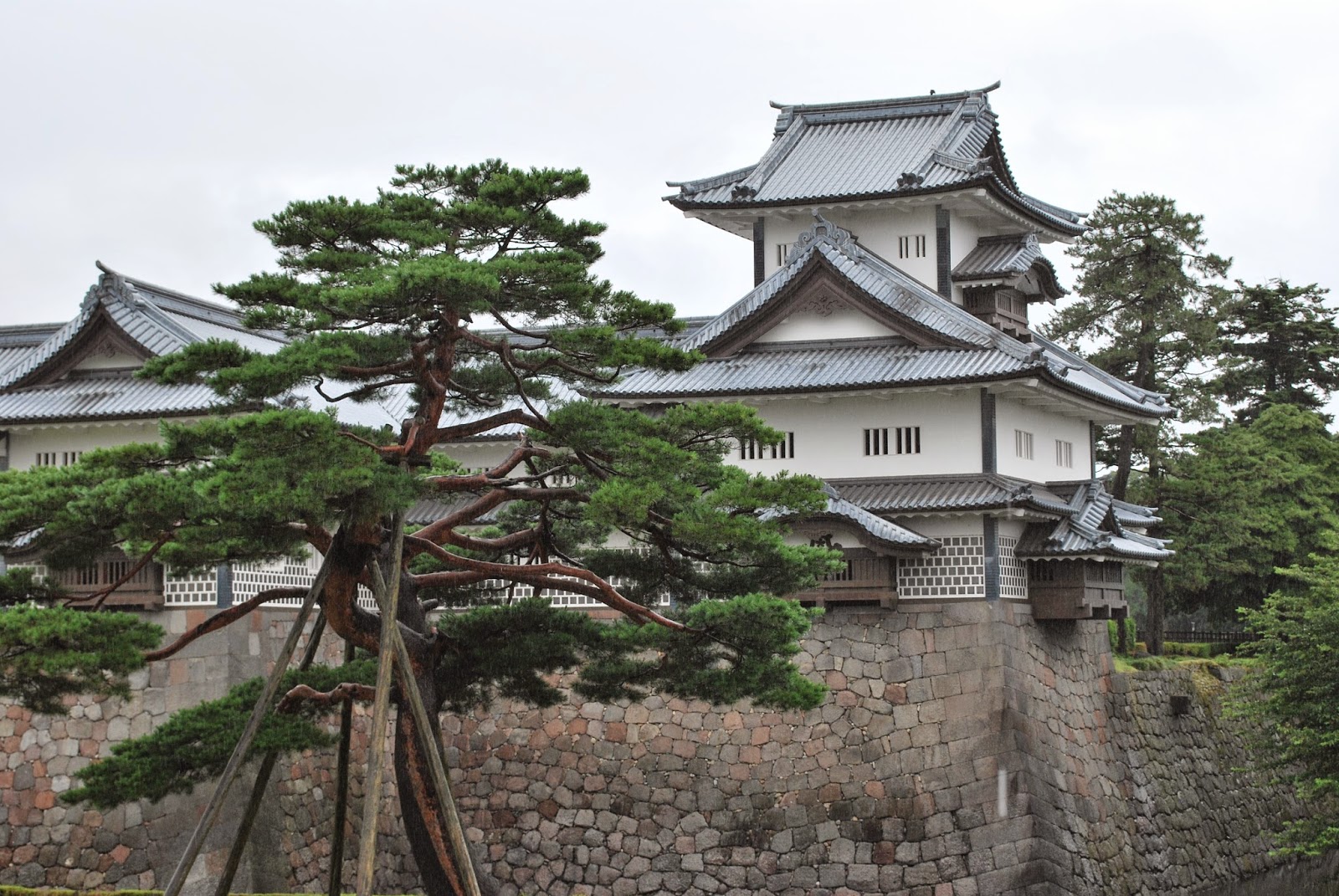
soon found myself within Kanazawa's castle park. Due to the rain I
pretty much had the whole park to myself. I planned a logical walking
route which would allow me to see the whole park in the shortest
time. Some of the park – and a part of the castle - were under
construction and so that limited the area I had to cover. Once again
I dotted from cover to cover taking the best shots possible.
Considering that the grounds were free I was very impressed; the
grounds had different areas consisting of different landscapes which
included an open grassy field area, the open grounds in front of the
castle, a small water garden and a small humid forest. I went through
each area (the forest, rather quickly) ticking
them off until I was content that I had seen all that there was to
see. Before leaving I checked the Castle Grounds Map once more,
content that all had been completed. I left the area and pushed on
towards a garden.
This
was no ordinary garden. As my guidebook put it:
“...
Early morning or late afternoon are the best times for catching
Kanazawa's star attraction, Kenroku-en at it's most tranquil,
otherwise your bound to have your thoughts interrupted at least once
by a megaphone totting guide and a party of tourists – such is the
price of visiting one of the official top three gardens in Japan.
Kenroku-en – developed over the last two centuries - is rightly
regarded as the best.
Originally
the outer grounds of Kanazawa's castle, and thus the private gardens
of the ruling Maeda clan, Kenroku-en was opened to the public in
1871. Its name, which means 'combined six garden', refers to the six
horticultural graces that the garden embraces: spaciousness,
seclusion, artificially, antiquity, water and panoramic views. It's a
lovely place to stroll around, with an ingenious pumping system which
keeps the hillside pools full of water and the fountains - including
Japan's first – working. There are sweeping views across towards
Kanazawa's old geisha district, Higashi Chaya, and many marvellous
pine trees, pruned carefully throughout the centuries to achieve a
certain shape...”
As
I paid the 350 Yen (£3) entrance fee I wondered that, if this
was Japan's official top Japanese garden then surely, that meant that
this was the best Japanese garden in the world. Due to the rain the
tourist groups had stayed away; the park was light with guests and so
I found it easy to move in between the parks different areas
photographing – when weather or cover allowed – at will. Japanese
gardens consist of many small walkways – lined with small bamboo
fences – with a main body of water somewhere. Usually there is
either a stone, or wooden arched bridge placed over said body of
water. This garden did not disappoint and even though it was summer,
somehow some of the trees were dressed in their autumn clothes. I
meandered this way and that. In between the maze of tiny paths lay
small mounds of grass with usually a tree or two on top and a couple
of rocks. Around each corner was another centre piece, which was very
different from the last. I was so lost in my 'zing and zang' world
that I almost didn't notice the skies becoming extremely black. When
I did eventually notice, I had pretty much seen the whole garden; I
therefore decided to quicken my pace and leave the 'worlds best
Japanese garden' and head to the 21st Century art gallery
(another must within my guidebook however, I just wanted somewhere
to get out of the rain). I had, of course, left it a little too
late and heavy rain started to pour down as I left the gardens. I
gave the ticket lady a bow and, from her little shed, she gave a
sympathetic one back. I raced across the road and into the art
gallery.
Japan
is not renown for wonderful architecture. I have found most of Japan
to consist of practical square-shaped boxes, only broken up by the
odd temple here and there. In Kanazawa I found two buildings where
beauty was higher on the agenda than practically; one was the
eastern-entrance to the train station and the other was this 21st
art gallery. The art gallery was circular in shape with glass
outer-walls. Inside, the exhibitions were split into three important
themes (free exhibitions, standard collection which you had to pay
for and a temporary exhibition which you also had to pay for). Due
to the layout of the building these all appeared to be jumbled up
with one another however, I didn't mind; getting confused and
back-tracking was a small price to pay for actually finding a
Japanese building which wasn't boring in design. I looked around all
of the free exhibitions before heading to the ticket office to decide
what I was going to view. The art galleries standard collection was
360Yen (£3) to view whereas a combined ticket to both the art
galleries collection and the temporary collections cost 1,000Yen.
Being low on cash I decided to leave the art gallery and head to the
local post office for more funds. The rain had died down again and it
was in this time that I had a think about which ticket I wanted to
buy.
Buy
the time I had returned to the art galleries ticket desk I had
decided to opt for the art galleries standard collection only. The
lady tried to give me the 'hard sell' however, she could tell that my
mind was made up. I thanked her and proceed to where she had told me
to go.
The
art galleries collection focused on 'reflections and viewing things
through things' (hence why the buildings outer-walls were all made
from glass). I could mock this collection as some of it consisted
of looking through glass, a big black oval on a giant stone wall and
a small 'diver action figure' in a wine glass full of water encased
within a glass box (you looked at said action figure through a
periscope) however, I did actually quite enjoy it. I can't say
that I ever 'got' what the artists were trying to portray within the
works presented but, most pieces were very 'hands on'. Within twenty
minutes I had seen all that their was to see. I prepared myself to
venture back into the watery world outside.
The
only real mistake I had made today was with my choice of footwear.
Normally, the trainers I had on my feet were very comfortable
however, the rain which hit the pavements of Kanazawa had bounced
and, over the last four hours, socked my socks. I therefore shuffled
my way into a department store which, I had hoped, would have been
full of places for lunch. I was wrong. Instead, I entered a word
which was unknown to me. Three floors awaited all with small
boutiques housing clothes which the shop staff wore (whether this
was to entice you or warn you I could not decide). I was just
about to leave this nightmare of commercialism when I spotted a
'Vieda France' sandwich shop. It wasn't actually what I was looking
for but it 'would do'. I purchased two sandwiches, a cake and a
drink for £5 and sat down.
Whilst
reading my guidebook, I discovered that there were only two areas of
Kanazawa left to explore. The first is where Geisha are trained; this
area was a thirty minute walk east and with my feet protesting, I
left that for another trip. The final area housed some old samurai
era streets. Kanazawa escaped bombing within World War 2, therefore
the old stuff here is actually authentic. Luckily this area was where
I was currently located. Also the area flowed in the direction of my
hostel. After a quick meeting with my feet they agreed to one final
push and away we went.
The
area of Nagamachi was where the old samurai streets could be found.
The area was pretty small therefore, it didn't take me long to wander
the cobbled streets peering over the mustard-coloured earthen walls
into a private world of small Japanese gardens and beautiful samurai
era houses. This area reminded me of Kakunodate, which I visited two
years ago. It was beautiful and it was here that I decided that
Kanazawa is actually a very nice city. It seems to have something for
everyone with flashes modern art and modern architecture, in between
pools of old samurai houses and traditional Japanese gardens. If it
wasn't for the weather, I would say that this could be a contender
for somewhere new for me to live.
All
too soon the Samurai era faded into the 1980's box era. I instantly
recognised where I was and followed the request of my feet to go back
to my hostel. I stopped only once to pick up a cool bottle of coke
and, once at my hostel, I sat down with my computer and wrote up as
much of today's blog as I could.
Due
to the weather, I stayed within my hostel – watching 'Youtube'
videos – until about 7:30pm when I went out for dinner. I had
agreed with my feet that I wouldn't go far and so I went back to the
same restaurant I visited last night except this time, I had a curry.
As
I walked back to my hostel I noticed that, for the first time today,
the weather was almost perfect. It wasn't hot, humid or raining that
hard. A breeze was flowing through the city making it very pleasant
indeed.
Once
back at my hostel I uploaded this blog and prepared for an early
night because I knew an early morning would follow.
So
tomorrow I plan to get up early and leave Kanazawa before the morning
rush. I will have to make a stop for petrol and breakfast but after,
I will head straight to three UNESCO heritage villages before making
camp in the mountain city of Takayama ('Taka' means high and
'Yama' means mountain). Once again I have a curfew however, it's
10pm.
Toodle
Pip!
P.S.
There are a lot of French people here.


 Posts
Posts

